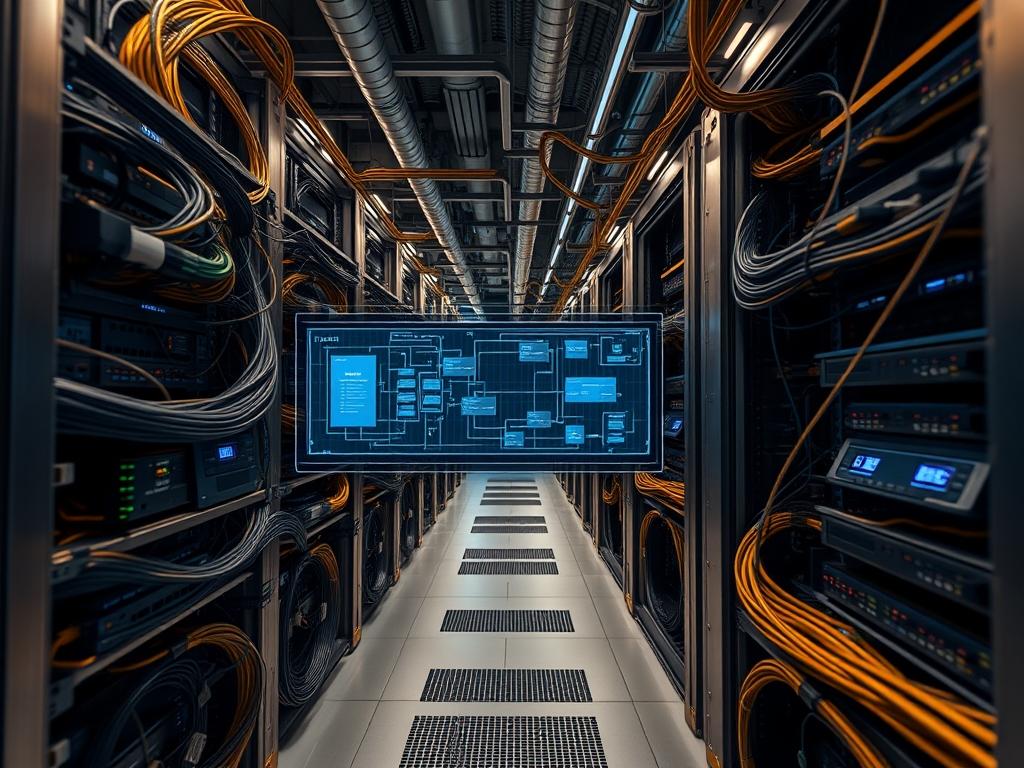
Data center fiber raceways represent the physical substrate of the high speed network layer; they are the critical structural components that ensure the integrity of the optical transport medium. Within the broader technical stack of cloud and network infrastructure, the raceway system functions as the protective encapsulation for the physical layer. The primary role of these systems is to manage the transition of high density fiber counts while mitigating the risks of mechanical stress and macroscopic bending. In a high throughput environment, even minor physical displacements can lead to significant signal-attenuation or total packet-loss.
The problem-solution context is defined by the need to scale physical connectivity without increasing the overhead of maintenance or the risk of unplanned outages. Conventional cable trays often lead to fiber crushing or excessive accumulation that impedes airflow, increasing the thermal-inertia of the cabling zone. Professional data center fiber raceways provide a dedicated, non-intrusive pathway that isolates optical fibers from power cabling and copper media. This segregation is essential for maintaining electromagnetic compatibility and providing a clear, idempotent installation path for future expansion. By implementing a standardized raceway system, architects ensure that the physical infrastructure supports the deterministic latency requirements of modern distributed applications.
Technical Specifications
| Requirement | Default Port/Operating Range | Protocol/Standard | Impact Level (1-10) | Recommended Material/Grade |
| :— | :— | :— | :— | :— |
| Minimum Bend Radius | 2 inches (50.8 mm) | TIA/EIA-568.3-D | 10 | LSZH Polycarbonate |
| Loading Capacity | Up to 50 lbs per linear ft | GR-449-CORE | 8 | UL94-V0 Rated Plastic |
| Thermal Resistance | -40C to +70C | UL 2024 | 7 | Noryl or Flame-Retardant ABS |
| Cable Segregation | 12-inch Vertical Clearance | NEC Article 770 | 9 | Rigid Sidewall Construction |
| Transition Integrity | 90-degree Sweep | Bellcore NEBS | 9 | Smooth-radius Molded Fittings |
The Configuration Protocol
Environment Prerequisites:
Before the physical deployment of Data Center Fiber Raceways, the site must verify compliance with TIA-942 (Data Center Infrastructure Standard) and NEC Article 770 (Optical Fiber Cables and Raceways). All installation personnel must possess administrative clearance for the specific containment aisles. Necessary hardware tools include a digital laser level, torque wrench (inch-lbs), optical time-domain reflectometer (OTDR), and a modular scaffolding system. If integrating with automated monitoring, ensure the logic-controllers for the facility management system are updated to the latest stable firmware to recognize new proximity or thermal sensors.
Section A: Implementation Logic:
The engineering design of a fiber raceway focuses on the “Passive Guidance Principle.” Unlike copper networking where signal degradation is primarily driven by electromagnetic interference, fiber optic performance is contingent upon the geometric stability of the glass core. The logic behind a dedicated raceway is to eliminate the compression of the optical payload. Compression or tight bends cause light to escape the fiber core into the cladding, a phenomenon known as signal-attenuation. By providing a rigid, smooth-surfaced path, the raceway ensures that the angle of incidence for internal reflection remains constant. Furthermore, the use of LSZH (Low Smoke Zero Halogen) materials reduces the risk of toxic gas emission in fire scenarios, protecting both the physical assets and the human operators within the facility.
Step-By-Step Execution
1. Structural Grid Alignment
Utilize a digital laser level to project the primary path of the Yellow Fiber Duct across the ceiling grid or sub-floor pedestals. Ensure the path maintains at least 12 inches of clearance from any high-voltage busbars or power distribution units.
System Note: This action establishes the physical topology of the network’s transport layer. Correct alignment prevents mechanical shear on the Fiber Optic Connectors and minimizes the physical overhead of future cable tracing.
2. Support Bracket Installation
Fix the threaded rod assemblies to the overhead structural members using 1/2-inch drop-in anchors. Torque all mounting bolts to 15 foot-pounds to ensure structural stability against seismic events or heavy cable loads.
System Note: This step secures the chassis of the raceway. Improperly torqued supports can lead to sagging, which introduces unpredictable signal-attenuation as the cable weight shifts over time.
3. Primary Channel Assembly
Snap the straight duct sections into the support brackets starting from the Main Distribution Area (MDA). Use joiner kits to connect duct lengths; ensure that the locking tabs click firmly into place without gaps.
System Note: The assembly of the channel creates a continuous, protected environment for the fiber. This provides physical encapsulation that shields the fiber from accidental contact during unrelated maintenance activities on the server racks.
4. Transition and Waterfall Integration
Install 90-degree horizontal elbows and T-junctions at all planned diversion points. At the point where fiber enters a rack, attach a Fiber Waterfall Outtake to ensure the cable transitions from the horizontal plane to the vertical plane without exceeding the minimum bend radius.
System Note: Waterfalls and transitions act as the physical “routers” for the cable flow. They prevent macro-bends, which are the leading cause of packet-loss in the physical layer of the data center.
5. Final Path Validation and Labeling
Conduct a physical inspection of the entire run to ensure no sharp edges are present. Apply serialized labels to the exterior of the Raceway every 10 feet in accordance with TIA-606-C standards for administration of telecommunications infrastructure.
System Note: Labeling is the metadata layer for physical assets. It allows the systemctl equivalent of physical troubleshooting mapping logical circuits to their exact physical location within the ducting.
6. Optical Verification
Connect a Fluke CertiFiber Pro or an OTDR to the fibers installed within the raceway. Execute a bi-directional test to measure decibel (dB) loss across the entire span at 1310nm and 1550nm wavelengths.
System Note: This step verifies that the installation has not compromised the throughput of the fiber. It ensures that the concurrency of data streams across multiple ribbons is maintained without interference from mechanical stress.
Section B: Dependency Fault-Lines:
The primary bottleneck in fiber raceway systems is “Growth Congestion.” As more fibers are added, the weight can cause the bottom-most cables to exceed their compression limit. This is particularly prevalent in 4×12 inch ducts where the cable pile height exceeds 3 inches. Another common failure point is “Thermal Expansion Mismatch.” If the raceway is installed in a high-temperature zone near hot-aisle containment, the plastic may expand at a different rate than the metal supports, leading to buckling. Always verify the thermal-inertia ratings of the selected materials against the projected heat output of the server loads.
THE TROUBLESHOOTING MATRIX
Section C: Logs & Debugging:
Physical faults in the raceway are often diagnosed through “Loss Budgets” rather than digital error logs. However, link-state sensors on the network switches will report RX Loss or high BER (Bit Error Rate) if the raceway integrity is compromised.
- Error: High dB Loss at a specific junction.
Diagnosis: Inspect the T-junction or Elbow for “Cable Bunching.” This occurs when the payload* of fiber strands is too high for the radius of the turn.
* Resolution: Redistribute fibers using a Downspout Kit or increase the width of the Horizontal Cross fitting.
- Error: Physical Sags in the Duct.
* Diagnosis: Distance between Support Brackets exceeds center-to-center recommendations (usually 5 feet).
* Resolution: Install additional Threaded Rods and Trapeze Brackets at the midpoint of the sag.
- Error: Visual Micro-cracks in Duct Polycarbonate.
* Diagnosis: Chemical incompatibility or excessive UV exposure. Check if cleaning agents containing ammonia were used.
* Resolution: Replace affected sections immediately with LSZH-compliant components and clean only with isopropyl alcohol.
OPTIMIZATION & HARDENING
Performance Tuning:
To maximize the throughput of the cable management system, implement “Fiber Segregation Layers.” Use internal dividers within the Fiber Raceway to separate high-priority backbone trunks from local patch cords. This reduces the risk of “cable knitting,” which complicates troubleshooting and increases the time required for hardware refreshes. Ensure that no individual duct exceeds a 40 percent fill ratio to allow for adequate airflow and future expansion without increasing the latency of maintenance operations.
Security Hardening:
Physical security of the fiber path is critical for data integrity. Use snap-on covers for all sections of the raceway to prevent unauthorized tapping or accidental damage. In high-security environments, utilize locking joiner kits that require a specific tool for removal. This creates a physical “firewall” around your transport layer. Furthermore, integrate vibration sensors along the support grid that report to the logic-controllers of the security system; this provides early warning of physical tampering or structural failure.
Scaling Logic:
A scalable raceway design is idempotent in nature; adding more capacity should not change the fundamental performance of the existing runs. Use “Express exiting” modules that allow fibers to bypass intermediate racks and go directly to the core switches. As the data center grows, use “Over-the-Rack” mounting strategies to reclaim floor space, ensuring that the thermal-inertia of the facility remains within the design parameters for the cooling system.
THE ADMIN DESK
How do I calculate the capacity of a 4×4 fiber raceway?
A standard 4×4 duct safely holds approximately 250 to 300 3mm patch cords. For high-density 2mm cords, capacity increases to 450. Always maintain a 40 percent fill ratio to prevent signal-attenuation from cable weight and compression.
Can I mix copper and fiber in the same raceway?
No. Standard practice and NEC codes prohibit mixing copper and fiber in the same Yellow Fiber Duct. Copper cables are heavier and can crush fiber. Additionally, segregated paths prevent electromagnetic interference from affecting copper data throughput.
What is the maximum distance between support brackets?
For most Noryl or PVC raceways, support brackets must be placed every 4 to 5 feet. Spans exceeding this distance risk deformation under full cable loads, leading to misaligned transitions and potential packet-loss due to stress.
How do I handle fiber exits into open-frame racks?
Use a Waterfall Outlet or a Trumpet Flare. These components ensure that the fiber maintains its minimum bend radius as it leaves the rigid raceway, protecting the payload from sharp edges on the rack frame.
What is the best way to clean a fiber raceway?
Use a vacuum with a HEPA filter to remove dust. Avoid compressed air, as it can push debris into Fiber Optic Connectors. Only use lint-free wipes and isopropyl alcohol for stubborn marks on the Polycarbonate ducting.