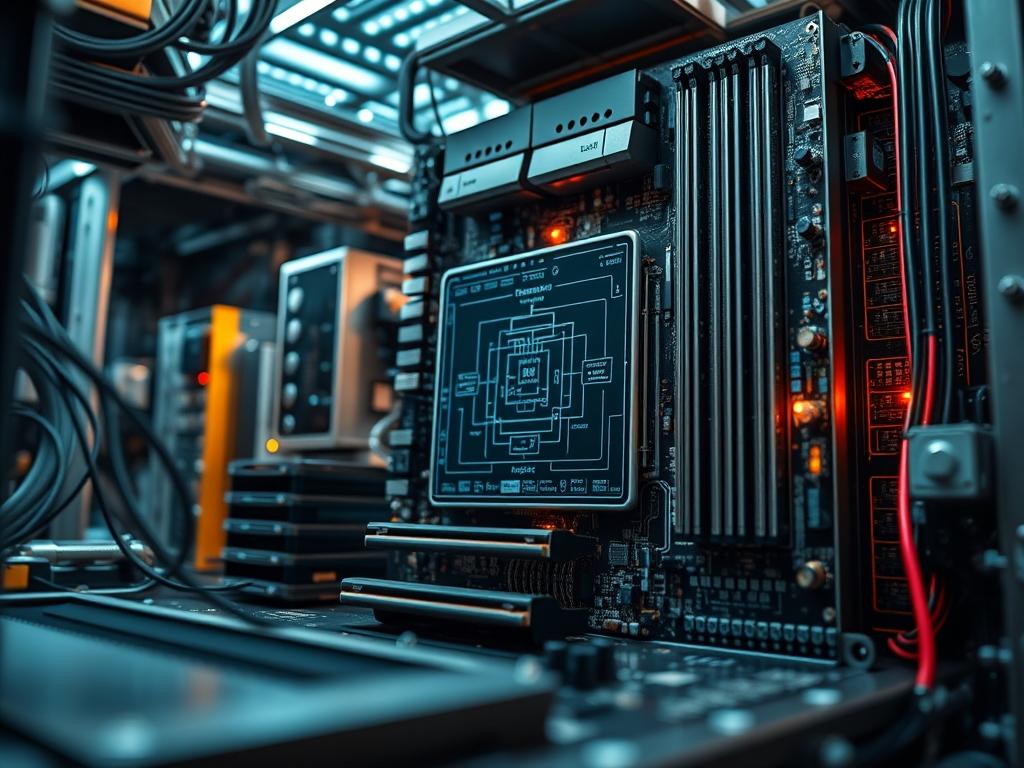
Dual socket motherboard architecture serves as the primary mechanism for scaling vertical compute density within modern cloud and network infrastructure. In the context of large scale data centers, the transition from single socket to dual socket configurations defines the shift from general purpose computing to high throughput, multi tenant environments. This architecture addresses the critical problem of resource saturation at the socket level by providing a redundant and high speed path for inter processor communication. By integrating two physical Central Processing Units (CPUs) on a single Printed Circuit Board (PCB), systems architects can effectively double the available core count and memory bandwidth without increasing the footprint of the physical rack unit. This design is essential for handling high concurrency workloads where the payload requires massive parallel processing. The primary challenge in this engineering design is managing the overhead associated with the cache coherency protocols and ensuring that signal-attenuation across the interconnect links does not compromise system stability or increase memory latency beyond acceptable thresholds.
TECHNICAL SPECIFICATIONS
| Requirement | Default Port/Operating Range | Protocol/Standard | Impact Level (1-10) | Recommended Resources |
| :— | :— | :— | :— | :— |
| Inter-Processor Link | 10.4 to 11.2 GT/s | Intel UPI / AMD Infinity Fabric | 10 | 96-Lane PCIe Gen 5 |
| Memory Topology | 2933 to 5600 MT/s | DDR4/DDR5 Registered ECC | 9 | Octa-Channel Per Socket |
| Thermal Management | 150W to 400W TDP | IEEE 802.3ad / PMBus | 8 | Liquid Cooling or High-CFM Fans |
| Power Delivery | 12V EPS / 48V DC | ATX12V / EPS12V | 9 | 1600W+ Platinum PSU |
| Baseboard Mgmt | Port 623 (UDP) | IPMI 2.0 / Redfish | 7 | ASPEED AST2600 BMC |
THE CONFIGURATION PROTOCOL
Environment Prerequisites:
The deployment involves high density hardware requiring specific environmental controls. The facility must adhere to ASHRAE A1 standards for temperature and humidity to manage the thermal-inertia generated by dual high TDP processors. Electrical requirements include NEMA L6-30P outlets to support redundant power supplies. At the software level, the UEFI Firmware must be updated to the latest vendor specific microcode to ensure compatibility between stepping versions of the CPU units installed. Administrative access to the Baseboard Management Controller (BMC) via a dedicated management network is required for out of band monitoring.
Section A: Implementation Logic:
The logic of dual socket architecture is centered on Non-Uniform Memory Access (NUMA). Unlike UMA (Uniform Memory Access) where all processors share a single memory pool with equal latency, NUMA divides the memory into regions local to each CPU. The engineering goal is to minimize the traversal of the CPU Interconnect (such as Intel UPI or AMD Infinity Fabric). When a process on CPU 0 requires data residing in the DIMM slots owned by CPU 1, the request must encapsulate the payload and transmit it across the interconnect. This introduces latency and consumes part of the available throughput. Therefore, the implementation logic focuses on “affinity,” ensuring that the kernel schedules threads on the same socket where the required data resides to reduce the overhead and prevent packet-loss or signal-attenuation across the traces of the Motherboard.
Step-By-Step Execution
1. Physical Processor and Socket Alignment
Prior to applying power, the architect must inspect the Land Grid Array (LGA) pins for any deviations. Seat CPU 0 (Primary) and CPU 1 (Secondary) into their respective sockets, ensuring the alignment triangles match the socket orientation.
System Note: This action ensures electrical continuity across thousands of contact points. Improper seating causes immediate signal-attenuation on the PCIe Lanes or Memory Channels, often resulting in a “Memory Training” failure during the Power-On Self-Test (POST).
2. Memory Population and Channel Balancing
Install the Registered ECC RAM modules starting with the slots furthest from the CPU according to the manufacturer’s population rules. Both sockets must have identical memory configurations to maintain an idempotent state across NUMA nodes.
System Note: The Integrated Memory Controller (IMC) initializes each channel. An unbalanced configuration forces the system into a lower frequency mode or disables interleaving, significantly reducing the system’s total throughput.
3. Verification of the Interconnect Links
Boot the system into the UEFI Setup Utility and navigate to the processor configuration menu. Verify that the UPI (Ultra Path Interconnect) or Infinity Fabric links are detected and operating at the maximum rated gigatransfer (GT/s) speed.
System Note: This step checks the integrity of the high speed data traces between sockets. If a link is down, the Kernel may still boot but will exhibit extreme latency whenever a cross-socket memory access occurs.
4. Baseboard Management Controller Initialization
Connect a network cable to the Dedicated IPMI Port and assign a static IP address via the BMC interface. Use the command ipmitool lan set 1 ipaddr 192.168.1.50 to establish remote connectivity.
System Note: The BMC acts as an independent processor that monitors the thermal-inertia and voltage rails of the Motherboard. It allows for remote power cycling and hardware level debugging through the Serial-over-LAN (SoL) interface.
5. Operating System Kernel Optimization
Once the OS is installed, utilize the numactl utility to verify the topology. Execute the command numactl –hardware to view the proximity of memory to each CPU core.
System Note: The Linux Kernel uses this information to perform intelligent task scheduling. By correctly identifying NUMA boundaries, the scheduler minimizes the frequency of cross-socket context switching, thereby reducing the computational overhead.
Section B: Dependency Fault-Lines:
The most frequent failure point in a dual socket motherboard architecture is the “Mismatched CPU” error. Both processors must share the same model number and stepping level; using a Xeon Gold 6330 alongside a Xeon Gold 6330N may lead to initialization failures or unpredictable behavior in the AVX-512 instruction sets. Another significant bottleneck is the thermal-inertia of the chassis. In a 1U or 2U rackmount server, the air exhausted from CPU 0 often flows directly over CPU 1. Without high static pressure fans, CPU 1 will hit thermal limits prematurely, causing the internal clock frequency to throttle and inducing jitter in latency sensitive applications.
THE TROUBLESHOOTING MATRIX
Section C: Logs & Debugging:
When the system fails to initialize, the first point of audit is the POST Code Display on the Motherboard. A code such as “0x55” typically indicates a memory initialization error, while “0x00” or “0xFF” suggests a core power rail failure.
In a running system, the dmesg log is the primary source of truth. Use the command dmesg | grep -i “NUMA” to ensure the kernel has successfully mapped the memory regions. If the log displays “No NUMA configuration found,” the system is likely running in a degraded UMA emulation mode.
For physical link issues, use ipmitool sel list to view the System Event Log. Look for “Correctable ECC” errors or “UPI Link Width Reductions.” These entries point toward physical degradation of the socket pins or signal-attenuation caused by electromagnetic interference. If a specific DIMM slot shows frequent errors, utilize dmidecode -t memory to map the logical error to the physical silk screen label on the Motherboard.
OPTIMIZATION & HARDENING
Performance Tuning
To maximize throughput, enable “Sub-NUMA Clustering” (SNC) within the BIOS. SNC splits each physical CPU into two virtual NUMA nodes, further reducing the distance data travels within the processor cache hierarchy. Additionally, set the Power Management Profile to “Maximum Performance” to prevent the CPU from entering low power C-states. While this increases energy consumption, it eliminates the wake-up latency incurred when a core resumes from a sleep state, which is critical for high concurrency network packets.
Security Hardening
Physical security starts with the TPM 2.0 (Trusted Platform Module). Ensure the TPM is initialized to store encryption keys for BitLocker or LUKS. At the networking level, restrict the IPMI port to a management-only VLAN and apply strict Firewall rules on the gateway to prevent unauthorized IPMI/RMCP+ traffic. Change the default factory credentials for the ASPEED BMC immediately to mitigate the risk of remote firmware implantation.
Scaling Logic
Maintaining this setup under high load requires a “Scale-Out” philosophy. Once the dual socket motherboard architecture reaches its ceiling of 128 or 256 logical threads, further scaling should involve adding more nodes rather than attempting to find a four socket solution, which significantly increases the complexity of cache coherency. Use automated provisioning tools like Ansible or Terraform to deploy idempotent configurations across a cluster of these dual socket nodes, ensuring that the Sysctl parameters for memory overcommit and hugepages are consistent across the entire infrastructure.
THE ADMIN DESK
How do I identify which CPU is failing?
Check the BMC sensors or the POST LEDs. On most enterprise boards, a red CATERR LED near a specific socket indicates a catastrophic error on that processor. Use the command ipmitool sdr list to view real time voltage levels.
Why is half of my RAM not showing up?
This is usually caused by an unseated CPU 1 or a bent pin in the second socket. Because the memory controller for those slots resides inside the second processor, the Motherboard cannot address that RAM if the processor is not fully initialized.
What is the impact of mismatched CPU steppings?
Mismatched steppings can cause the system to disable certain instruction sets (like AES-NI) to maintain parity. In some cases, the UEFI will prevent the system from booting, citing a “CPU Microcode Load Error” to prevent data corruption.
How do I reduce cross-socket latency?
Use taskset or numactl –physcpubind to lock processes to the cores of a single socket. By pinning the application to the local NUMA node, you bypass the UPI or Infinity Fabric link entirely for memory operations.
Is liquid cooling necessary for dual socket boards?
It depends on the TDP. For high end processors exceeding 250W each, liquid cooling prevents the thermal-inertia of the first CPU from overheating the second. For standard loads, high static pressure fans in a partitioned chassis are sufficient.